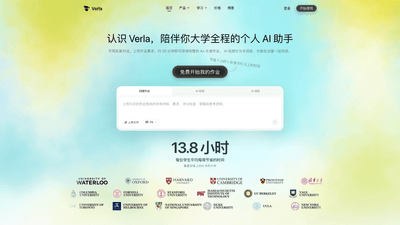
What is it
Verla is an AI-powered academic writing assistant designed to accompany university students throughout their studies. It functions as a personal, all-in-one AI assistant for coursework, enabling you to generate initial drafts, conduct AI detection, and polish final text within a single streamlined workflow. From uploading assignment requirements and rubrics to delivering A+ level essays, presentations, and coding projects in roughly 20 minutes, Verla covers the full spectrum of academic tasks. The platform emphasizes authentic sources, real citations, and rubric-aligned structure, while ensuring privacy and data protection. With global reach across 2,000+ universities and support for 50+ disciplines and 30+ assignment types, Verla strives to save significant study time and boost confidence in every submission.
Key highlights:
- AI-assisted generation of essays, papers, presentations, and programming tasks in about 20 minutes.
- Built-in AI detection and text polishing to reduce AI traces while preserving meaning and citations.
- Real academic references with verifiable sources and mainstream citation formats (APA, MLA, Chicago, IEEE, Harvard, Vancouver).
- Export options including Word, PDF, slides, and code, plus browser/email delivery.
- 20+ languages supported for AI detection and analysis; 50+ disciplines and 30+ assignment types covered.
- Privacy-first design and rubric-aligned quality checks that mirror professor expectations.
Features
- AI-generated drafts that align with your assignment requirements, scoring rubrics, and provided reading materials, enabling near-instant initial submissions.
- AI detection and tracing: precise AI-trace scoring and a paragraph-level view to show which sections may resemble templates; guidance on how to adjust to meet authentic, student-authored standards.
- Text polishing: refine tone, clarity, and flow without compromising arguments, evidence, or citations; reduces overly generic AI phrasing while preserving original meaning.
- Academic references and sources: retrieval of credible, citable sources; supports mainstream citation styles (APA, MLA, Chicago, IEEE, Harvard, Vancouver) with properly formatted references.
- Comprehensive writing and task coverage: supports essays, research papers, reports, case studies, literature reviews, experimental reports, research plans, reflections, annotated bibliographies, as well as presentations and posters.
- Programming and data work: supports Python, R, SQL, data analysis, algorithms, notebooks, and data visualization tasks; outputs suitable for assignments and projects.
- Multi-language capability: AI detection and polishing available in 20+ languages; useful for bilingual or multilingual research tasks.
- Rich professional feedback: professor-style quality checks focusing on clarity, evidence strength, structure, originality, and scholarly tone; ensures alignment with grading criteria.
- Export and delivery: export finalized work to Word, PDF, slides, or code; automatic notifications by browser or email when tasks are ready.
- Privacy and sourcing integrity: uploaded materials and personal data are protected; citations are verifiable and sourced from credible references.
How to Use
- Start for free: Begin with Verla’s free starter option to test core capabilities, including draft generation, AI detection, and polishing.
- Upload materials: Submit assignment requirements, grading rubrics, classroom notes, PDFs, books, datasets, and examples to anchor the output in real constraints.
- Generate and review: Verla analyzes the inputs, retrieves credible references, and generates a complete A+ level draft with structure, arguments, and citations. A third-party-like AI detection view helps you see potential AI signatures and refine accordingly.
- Polish and tailor: Use the built-in polishing tools to adjust tone and phrasing while preserving your ideas, citations, and evidence. The system highlights sections that may require adjustments to better fit authentic student work.
- Export and submit: Export the final version in Word, PDF, slides, or code formats. You can also receive deliverables via browser or email for convenient submission.
- Pricing options: Verla offers a free start, with premium tiers that unlock full drafting, advanced AI detection insights, deeper polishing, broader language support, and more export formats. Pricing details are provided on the official site or through sales channels.
Practical use scenarios:
- Undergraduate essays and literature reviews that require precise citation formatting (APA, MLA, Chicago, IEEE, etc.).
- Research papers and lab reports that demand robust structure, evidence, and scholarly tone.
- Presentations and posters that need clean formatting and consistent style across slides or posters.
- Programming assignments and data projects that require clean notebooks, readable code, and citation-backed analyses.
- Multilingual study where AI detection and polishing are needed in multiple languages without losing academic rigor.
Pricing
Verla offers a free start option to begin exploring its capabilities, including draft generation, AI detection, and polishing. For users seeking advanced features, premium plans provide enhanced AI detection insights, deeper editorial polishing, broader language support, expanded export options, and priority support. Specific pricing details are available on the official Verla site or by contacting sales. If you’re evaluating Verla for ongoing academic use, you can start with the free tier and scale to a paid plan as your needs grow.
Tips
- Provide complete upfront context: include assignment rubrics, goals, and any classroom notes to help Verla generate a draft that truly matches expectations.
- Use credible references: Leverage the “real references” feature to ensure sources are authentic and properly cited in your preferred format.
- Leverage the paragraph-level view: After generation, inspect the AI-detection view to identify template-like passages and revise them to preserve your unique voice.
- Align with rubrics: Review professor-style checks (clarity, evidence, structure, originality, and tone) to ensure your final draft meets grading criteria.
- Keep iterations tight: Instead of reworking large sections, target specific paragraphs or arguments that need refinement to maintain coherence and argumentative flow.
- Review citations: Always verify each citation and its linking reference to ensure accuracy and accessibility.
- Export readiness: Use Word or PDF exports for submission; slides exports help with presentation preparation; coding tasks can be exported in notebook or script formats.
- Privacy first: Be mindful of sensitive data; Verla emphasizes data privacy and controlled sharing of your materials.
Frequently Asked Questions
-
What exactly can Verla generate?
Verla can generate complete A+ level assignments, including essays, research papers, reports, literature reviews, case studies, experimental reports, research plans, and reflections, as well as presentations and posters. It also supports programming and data tasks in Python, R, SQL, and notebooks. -
How long does it take to get a draft?
Approximately 20 minutes from upload of requirements and sources to a complete draft, depending on the task type and depth of research needed. -
Is AI detection part of the workflow?
Yes. Verla includes precise AI-detection results with paragraph-level analysis to identify potential AI traces. It also provides guidance on how to reduce detectable AI signatures while preserving meaning, citations, and academic integrity. -
Can Verla handle citations and references?
Absolutely. Verla retrieves verifiable academic sources and formats citations in APA, MLA, Chicago, IEEE, Harvard, Vancouver, and other standard styles. It supports exporting well-formatted reference lists. -
Which disciplines and task types are supported?
More than 50 disciplines and over 30 assignment types are supported, including essays, research papers, reports, literature reviews, case studies, experimental reports, presentations, posters, and programming/data tasks. -
What languages are supported for AI detection?
The AI detection feature supports 20+ languages, helping multilingual students and researchers manage authenticity across languages. -
Can I export the final work to different formats?
Yes. Final outputs can be exported to Word, PDF, slides, and code (where applicable), and you can receive deliverables via browser or email notifications. -
How is my privacy protected?
Verla’s privacy-by-design approach ensures uploaded materials and personal data are safeguarded and not publicly shared. Citations are verifiable, and data handling adheres to established privacy policies. -
Do I still need to review the work myself?
Yes. While Verla provides draft generation, detection insights, and polishing, you should review outputs to ensure alignment with course-specific expectations and to inject your unique voice and critical perspective. -
Is there a mobile app or is it browser-based?
Verla is browser-based with export and notification options; you can access it from common devices and receive updates by email or browser notifications. -
How do I access pricing and upgrade plans?
Pricing and plan details are available on the official Verla website or through direct contact with the sales team.
This comprehensive overview highlights Verla as an AI-driven academic writing assistant that combines draft generation, AI detection, and text polishing into a single, rubric-aware workflow. Its emphasis on authentic sources, multi-language support, broad discipline coverage, and flexible export options positions it as a valuable tool for students and researchers seeking efficient, high-quality academic outputs.