What is it
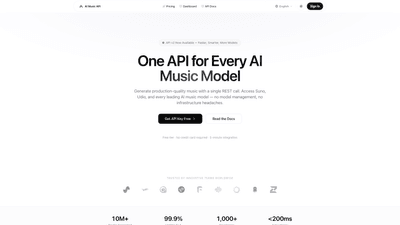
The AI Music API is a unified REST API that gives developers seamless access to multiple leading AI music generation models—from Suno and Udio to Stable Audio and MusicGen—through a single, consistent interface. Instead of juggling separate integrations for each provider, you can generate production-quality music with one endpoint, manage models with one parameter, and focus on building compelling audio experiences in apps, games, videos, podcasts, and more. The platform emphasizes speed, reliability, and commercial readiness, with a generous free tier, low latency, and enterprise-grade security.
Key benefits include instant API keys on signup, no upfront hardware needs, and a scalable path from rapid prototyping to production-scale implementations. The API is designed for developers who want fast iteration, predictable costs, and full control over the musical output.
Features
- Unified multi-model access: Switch between Suno, Udio, Stable Audio, MusicGen, and other supported models with a single parameter. Choose the best model for your needs without changing your codebase.
- Lightning-fast inference: Optimized pipelines deliver generated audio in seconds, with average latency under 200ms and robust performance at scale.
- Global edge delivery: Requests are routed to the nearest edge node to ensure the lowest possible latency for users worldwide.
- End-to-end security: SOC 2 compliant infrastructure with end-to-end encryption and fine-grained API key permissions to protect your team.
- Real-time usage analytics: A live dashboard tracks generation counts, costs, rate limits, and alerts to help you stay within budget.
- Full audio control: Fine-tune genre, mood, tempo, duration, and instruments. Create dynamic soundtracks and tailored cues for your project.
- Lyrics and vocals: Some models can generate vocals with lyrics; provide a lyrics parameter to embed lyrical content.
- Flexible output formats: MP3 is the default delivery format; WAV and FLAC are also supported depending on the model and request.
- Commercial licensing included: Generated music is fully licensed for commercial use with no royalty fees, simplifying legal and licensing concerns.
- Async and webhooks: Use asynchronous generation with status polling or webhook callbacks when a track completes or fails.
- 2–4 minute capabilities: Most generations fall within 2–4 minutes per track, with options to extend using continuation endpoints.
- Free tier and easy onboarding: A generous free tier, no credit card required to start, and streamlined steps to your first track in minutes.
- SDKs and documentation: Official SDKs for Python and JavaScript complement the REST API, along with comprehensive docs and a developer community.
Use Cases
- Game development: Generate adaptive, genre-spanning soundtracks that respond to in-game events, tempo shifts, and energy levels.
- Mobile and web apps: Create personalized intros, background music, and jingles for apps and onboarding flows.
- Video production and podcasts: Produce mood-appropriate music for intros, transitions, and scenes without licensing headaches.
- Advertising and brand campaigns: Rapidly test multiple musical moods and genres to match branding and storytelling.
- Prototyping and MVPs: Move from idea to prototype in minutes, then scale to production with enterprise-grade reliability.
Core strengths include rapid prototyping, easy model switching, and a single integration path that accelerates development timelines while preserving creative control.
How to Use
- Sign up and get your API key in minutes (free tier available; no credit card required for start).
- Choose a model: Suno, Udio, Stable Audio, or MusicGen. Each model has its own strengths; the docs guide you to the best choice for your prompt.
- Send your first request via POST with your prompt, selected model, and parameter settings (genre, mood, tempo, duration, instruments). You’ll receive a task ID to poll for status or a webhook to notify upon completion.
- Retrieve and use the result: When processing completes, you’ll get an audio URL. Download and embed the track in your app, game, video, or other project.
- Optional advanced steps: Use asynchronous webhooks for long compositions, experiment with lyrics-enabled prompts, and extend tracks with continuation endpoints if you need longer runtimes.
Pricing is credit-based: a generous free tier to prototype, followed by paid plans where each generation consumes a fixed number of credits depending on the model and duration. You can see exact credit costs on the pricing page. Rate limits scale with your plan, with enterprise options for custom needs.
Pricing
- Free tier: Generous start-up allowances to explore capabilities, no credit card required to begin, and your API key is issued instantly.
- Paid plans: Credit-based pricing—each generation deducts credits according to the model and duration. This provides predictable costs and easy budgeting as you scale.
- Rate limits: Free tier includes a base rate limit (for example, 10 requests per minute). Higher limits are available with paid or enterprise plans.
- Commercial use: All paid plans include full commercial rights—no royalty fees—so generated music can be used in apps, games, videos, podcasts, and other commercial projects.
- Enterprise: Custom pricing and SLAs with dedicated support and higher or bespoke rate limits.
Tips
- Start with the free tier to prototype quickly. Validate your use case and music style before upgrading.
- Model selection strategy:
- Suno variants for vocal content or singer-like phrasing with expressive timing.
- Udio for efficient, high-quality instrumental tracks and broad genre support.
- Stable Audio for stable, consistent textures ideal for background music.
- MusicGen for diverse, genre-spanning outputs and explorations.
- Prompt design: Refine prompts with explicit genre, mood, tempo, duration, and instrument constraints to steer the output precisely. Combine multi-genre prompts to craft dynamic soundtracks.
- Lyrics generation: If vocals are needed, include a lyrics directive and select a model that supports singing. Lyrics can be added or generated by the model as part of the prompt.
- Webhooks and async workflows: Use webhooks for long-form compositions to avoid blocking your app. Polling or webhook-based updates help you scale without latency concerns.
- Monitor costs: Leverage the real-time analytics dashboard to track generation counts, costs, and quotas. Set alerts to prevent budget overruns.
- Extend tracks: If you need longer music, use the continuation or extend endpoints to append segments, preserving coherence across a longer composition.
- Integration readiness: Start with the SDKs for Python or JavaScript to accelerate integration, then migrate to custom code as needed.
Frequently Asked Questions
- What is the AI Music API? A single REST API that provides access to multiple AI music generation models (Suno, Udio, Stable Audio, MusicGen) with a consistent interface, eliminating the need to integrate each provider separately.
- How does pricing work? There is a free tier to get started; paid plans use a credit-based system where each generation costs a fixed number of credits depending on the model and duration.
- What audio formats are supported? MP3 is the default; WAV and FLAC are also supported by some models. You can specify the desired format in the API request.
- Do I own the music I generate? Yes. All music generated via the API is fully licensed for commercial use with no royalty fees.
- Which models are available? Suno (V4 and V3.5), Udio, Stable Audio, and MusicGen, with new models added as they become available.
- Is there a rate limit? Free tier has a base rate limit (e.g., 10 requests per minute). Paid plans offer higher limits; enterprise plans can have custom limits.
- How long does generation take? Most tracks generate in about 30–120 seconds, depending on the model and requested duration. Async options minimize latency in your app.
- Can I use this for commercial projects? Absolutely. Paid plans include full commercial rights; suitable for apps, games, videos, podcasts, and more.
- What languages are supported for integration? The API uses JSON and works with any programming language. Official SDKs are available for Python and JavaScript.
- Can I generate lyrics along with music? Yes, several models (including Suno) can generate vocals with lyrics when you include a lyrics parameter.
- What is the maximum song duration? Durations vary by model, generally up to 2–4 minutes per generation. You can extend with continuation endpoints.
- Is there a sandbox environment? Yes—the free tier serves as a sandbox for testing and prototyping.
- How do webhooks work? You can register a webhook URL; the API posts completion or failure events to your URL, enabling event-driven workflows.
- Can I fine-tune or train custom models? Custom model training is not currently available via the API. You can achieve precise results through detailed prompts and parameter tuning.
- What kind of support is available? Comprehensive documentation and a developer community are available to all users. Paid plans include priority email support; enterprise plans offer dedicated support with SLA guarantees.
If you’re seeking a scalable, developer-friendly way to harness multiple AI music models through one lightweight API, the AI Music API provides a powerful, production-ready solution with robust security, predictable pricing, and fast, high-quality musical outputs.