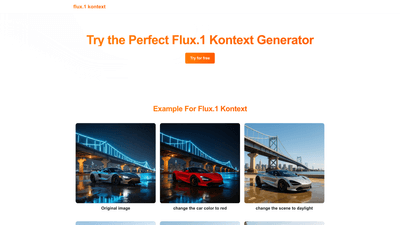
What is Flux.1 Kontext?
Flux.1 Kontext is a next-generation contextual intelligence engine designed for real-time data environments. Built to understand not just raw data but its meaning, behavior, and intent, Flux.1 Kontext enables dynamic, adaptive decision-making across fast-moving systems. It draws on reactive programming principles to provide seamless data flow, lower latency, and intelligent context awareness. Ideal for AI-driven tools, IoT ecosystems, and cloud-native platforms, Flux.1 Kontext offers a modular, API-first architecture that developers can integrate into workflows to interpret data in motion, reduce response times, and unlock advanced automation. In short, Flux.1 Kontext helps teams act on data when it matters most, future-proofing tech stacks with context-first computing.
Key Features and Capabilities
- Real-time contextual analysis: Continuously collects, analyzes, and interprets dynamic data streams to extract meaningful context and actionable insights.
- Layered, event-driven architecture: Bridges raw data and intelligent decisions through a robust, scalable design that supports complex data flows.
- Dynamic adaptability: Understands changing inputs, behaviors, and intents, enabling smarter, faster, and more flexible data-driven decisions.
- Modular, API-first integration: Easily connects with databases, cloud platforms, analytics tools, and third-party services without heavy reengineering.
- Low-code orchestration: Enables non-developers like business analysts and product teams to design contextual workflows, accelerating experimentation and deployment.
- Real-time automation enablement: Supports automatic responses and adaptive automation in fraud detection, recommendations, IoT automation, logistics, and more.
- Industry-grade performance: Engineered for low latency and high throughput to support time-sensitive applications and large-scale deployments.
- Context-first decisioning: Goes beyond traditional data processing by inferring meaning, intent, and behavior to guide actions rather than just reporting data.
Use Cases and Scenarios
- Fintech and financial services: Real-time fraud detection, risk scoring, and adaptive anomaly monitoring with immediate, context-aware responses.
- E-commerce and retail: Personalization, dynamic pricing, and contextual product recommendations that adapt as customer signals evolve.
- IoT ecosystems: Smart environments where devices, sensors, and controllers react to changing conditions with minimal delay.
- Smart cities and logistics: Real-time traffic management, predictive maintenance, and supply chain optimization driven by contextual insights.
- SaaS platforms: Contextual automation and workflow orchestration that adapt to user behavior and operational signals.
- AI-driven product tooling: Contextual data pipelines that feed intelligent models with timely, relevant information to improve outcomes.
How to Use Flux.1 Kontext
- Start with a modular integration: Connect Flux.1 Kontext to your data sources (databases, streaming services, IoT hubs) via its API-first interfaces.
- Define contextual signals: Identify the key data points, events, and intents that should drive actions within your workflows.
- Build contextual workflows: Use the low-code orchestration interface to design how Flux.1 Kontext interprets signals and triggers automated responses or routing decisions.
- Deploy and monitor: Roll out in real time with monitoring dashboards to track latency, accuracy of context interpretation, and automation outcomes.
- Iterate and optimize: As data patterns evolve, refine contextual rules, adapt models, and adjust workflows to maintain optimal performance.
Pricing (Free/Paid Tiers)
- Flux.1 Kontext offers a trial option to explore core capabilities with no upfront commitment, allowing you to evaluate integration complexity and performance.
- After trial, pricing is tiered based on data throughput, latency requirements, and the number of contexts/workflows you manage. Higher tiers provide:
- Increased real-time processing capacity
- Expanded API access and integration connectors
- Enhanced orchestration tooling and analytics
- Priority support and enterprise features
- Detailed pricing varies by organization size and use case; consult Flux.1 Kontext pricing documentation or contact the sales team for a tailored quote.
Benefits and Competitive Advantages
- Real-time intelligence with context: Unlike traditional data tools, Flux.1 Kontext understands the meaning and intent behind data, enabling timely and relevant actions.
- Reduced latency and faster decisions: The event-driven, contextual architecture accelerates insights-to-action cycles, improving responsiveness in critical scenarios.
- Flexible, scalable architecture: Modular design supports incremental adoption, from small pilots to large-scale deployments across multiple teams and domains.
- Empowered non-developers: Low-code orchestration empowers business analysts and product teams to prototype and deploy contextual workflows quickly.
- Future-proof data ecosystems: Context-first computing aligns with intelligent systems and AI-driven operations, helping organizations stay ahead of evolving tech demands.
Who Should Try Flux.1 Kontext
- Tech startups and scale-ups needing real-time adaptability and rapid experimentation.
- Enterprises seeking smarter, faster, and more flexible data-driven decisions.
- Teams focusing on AI-driven tools, IoT ecosystems, and cloud-native platforms.
- Business analysts and product teams who want to design and deploy contextual workflows without heavy coding.
Frequently Asked Questions
-
What makes Flux.1 Kontext different from traditional data processing tools? Flux.1 Kontext provides real-time contextual awareness, not just data handling. It understands data meaning, behavior, and intent, enabling dynamic, AI-driven environments with faster, smarter decisions.
-
Is Flux.1 Kontext suitable for real-time applications? Yes. It is optimized for low-latency processing of continuous data streams, supporting time-sensitive use cases like fraud detection, smart recommendations, and IoT automation.
-
How does Flux.1 Kontext integrate with existing systems? It features a modular, API-first architecture that facilitates seamless integration with databases, cloud platforms, analytics tools, and third-party services.
-
Can non-developers use Flux.1 Kontext? Yes. A low-code orchestration interface allows business analysts and product teams to build contextual workflows without deep technical knowledge, speeding up deployment and experimentation.
-
What industries benefit most from Flux.1 Kontext? Fintech, e-commerce, smart cities, logistics, and SaaS platforms—any sector needing real-time contextual insights to automate and enhance user experiences.
-
Is there a free trial available? Yes. Flux.1 Kontext offers a free trial to explore core capabilities before committing to a paid plan.
-
How is pricing structured? Pricing is tier-based, tied to data throughput, latency requirements, and the number of contexts/workflows. Enterprise features and priority support are typically part of higher tiers.
-
What kind of support and onboarding can I expect? Higher tiers include enhanced support, documentation access, and onboarding assistance to accelerate adoption and ensure successful deployments.
-
Can Flux.1 Kontext help with scalability? Absolutely. Its modular, event-driven design scales with your data volumes, number of contexts, and organizational needs, ensuring consistent performance as you grow.
Note: This product overview is based on Flux.1 Kontext’s described capabilities and should be complemented with official documentation and a live trial to validate specific features, integrations, and pricing for your organization.