What is it
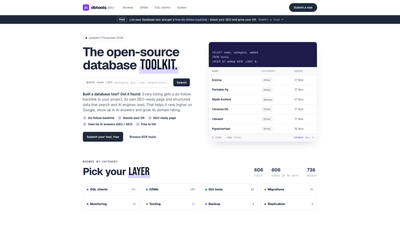
dbtools.dev is an open-source database toolkit directory designed to help developers discover, showcase, and boost the visibility of database-related tools. It aggregates a wide range of open-source solutions—including SQL clients, ORMs, migrations, monitoring, and GUI tools—into a single, SEO-friendly marketplace. Each listed tool receives its own dedicated, SEO-ready page with structured data, plus a do-follow backlink to the project. This combination helps tools rank higher on search engines, appear in AI-driven answers, and improve overall domain rating (DR). Submitting a tool is free, and there are no paid placements.
Features
- Free tool submission with no paid placements
- Do-follow backlink to the tool’s project page
- SEO-ready listing page with structured data (readable by search engines and AI systems)
- Increased discoverability in AI answers and GEO/AEO contexts
- Centralized catalog of open-source database tools (SQL clients, ORMs, migrations, monitoring, GUI tools, etc.)
- Up-to-date listings with clear metadata (tool name, category, added date)
- Category-based browsing and filters to navigate 606+ tools
- Regularly updated content and new additions (example tools include Encina, Portable Pg, Mydb Archive, Chronos Db, Pgvectorfast, Tardigrade, Cheesedb, Arduino Sqlite, among others)
- Guides and comparisons to help makers evaluate alternatives and choose the right tool
Core keywords: dbtools.dev, open-source database tools, SQL clients, ORMs, migrations, monitoring, GUI tools, free to list, do-follow backlink, SEO-ready page, structured data, AI answers, GEO/AEO, DR, tool submissions, tool directory
How to Use
- Submit a tool for free
- Visit the Submit a Tool page on dbtools.dev
- Provide essential details: tool name, category (SQL clients, ORMs, migrations, monitoring, etc.), concise description, project link, repository, and any relevant tags
- Submit—there are no fees or paid placements
- Manage and discover listings
- Use Browse All or browse by category to explore 606+ tools
- Sort by added date to see the newest entries (examples recently added include Encina, Portable Pg, Mydb Archive, Chronos Db, Cbvault, Pgvectorfast, Tardigrade, Cheesedb, Arduino Sqlite)
- Each listing displays the name, category, and the date added to help context and credibility
- Benefit from optimized visibility
- Your listing generates a dedicated SEO-friendly page with structured data
- The page is readable by search engines and AI systems, increasing chances of appearing in AI-generated results and search rankings
- The do-follow backlink sends referral authority back to your project, supporting SEO and domain rating growth
- Explore guides and comparisons
- dbtools.dev hosts guides and tool comparisons to help you evaluate options and understand how tools stack up against one another
Pricing
- Free to submit a tool
- No paid placements or premium tiers
- The platform emphasizes a merit-based exposure model: listings gain visibility through SEO-friendly pages and backlinks rather than paid slots
Tips
- Choose accurate categories: Align your tool with the most appropriate category (e.g., SQL clients, ORMs, migrations, monitoring) to maximize discoverability by users searching within that niche.
- Write a clear, keyword-rich description: Highlight core capabilities (e.g., embedded databases, vector search, real-time monitoring, archival support, cross-database compatibility) and include related terms potential users may search for.
- Provide precise metadata: Ensure your tool’s added date is accurate and keep descriptions up-to-date as features evolve.
- Leverage the backlink effectively: Use consistent naming in your own site and ensure the link from dbtools.dev points to a stable destination (e.g., project homepage or repository) to maximize the SEO value of the do-follow backlink.
- Enhance your own site’s SEO: Complement the listing by implementing structured data on your project pages (schema.org) and maintaining a well-documented, crawlable site.
- Engage your community: Encourage users and contributors to mention your tool in related forums or guides, which can lead to more natural backlinks and increased visibility within the dbtools.dev ecosystem.
- Monitor updates: If your tool receives major updates or new capabilities, consider updating the listing to reflect changes and maintain relevance for search and AI readers.
Frequently Asked Questions
- Is it free to submit a tool? Yes. Submitting a tool is free, and there are no paid placements on dbtools.dev.
- What does a listing give my project? A listing provides a do-follow backlink to your project, an SEO-ready page with structured data, increased visibility in search and AI results, and a clearly labeled category entry in a centralized directory.
- Where do the tools come from? The directory curates open-source tools across SQL clients, ORMs, migrations, GUI tools, monitoring, and related categories. If you know a tool that’s missing, you can submit it for inclusion.
- How is visibility determined? Visibility is driven by the SEO-friendly listing page and the associated do-follow backlink, as well as the tool’s relevance to user searches, rather than paid placements.
- How many tools are listed? The directory currently catalogs hundreds of tools (606 tools listed with ongoing updates and new entries, including recently added examples). You can browse by category or search to find relevant options.
- Can I manage or update my listing after submission? Yes. Listings are designed to be informative and up-to-date. Update the tool’s description, category, or links as needed to reflect new features or changes.
Overall, dbtools.dev offers a focused, high-value platform for open-source database developers to gain visibility, attract traffic, and improve their project’s credibility through free listings, do-follow backlinks, and SEO-ready pages. Whether you’re a tool author seeking broader reach or a developer evaluating database solutions, the directory consolidates essential SQL, ORM, migration, and monitoring tools in one accessible place.