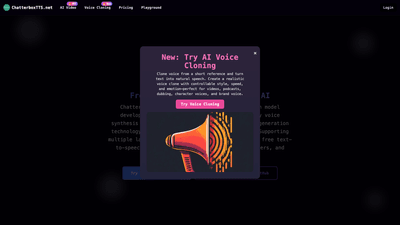
What is it
Chatterbox TTS is a free, open-source text-to-speech (TTS) model developed by Resemble AI. Available under MIT license, it delivers high-quality, natural-sounding voice synthesis with a focus on accessibility, customization, and ease of integration. The project is hosted on platforms like GitHub and Hugging Face Gradio, making it easy for developers, content creators, and educators to experiment without licensing hurdles. Notable strengths include zero-shot voice cloning from a short reference, expressive voice controls, and low-latency streaming for real-time applications. Chatterbox TTS emphasizes responsible AI through neural watermarking and a robust open-source community backing.
Key features and capabilities
- Free, open-source voice synthesis: No registration required to try basic capabilities; MIT-licensed code for broad adoption and modification.
- Zero-shot voice cloning: Reproduce a target voice from 7–20 seconds of reference audio using a powerful 0.5B Llama backbone, enabling personalized voices without lengthy training.
- Expressive voice control: A unique emotional exaggeration control (neutral default around 0.5) lets you calibrate tone, intensity, and pacing for dynamic content like storytelling, games, and marketing.
- Fine-grained voice customization: Adjustable parameters such as emotional intensity, pitch, voice style, and CFG weight (pacing) to tailor output to specific use cases.
- Reference-audio cloning: Upload a reference track to facilitate zero-shot voice cloning for accurate replication of a target voice.
- Low-latency, real-time streaming: Ultra-stable, alignment-informed inference supports interactive applications with sub-second first chunks on capable GPUs.
- Neural watermarking: Each generated audio includes a neural watermark to support traceability and responsible use, with high detectability even after common audio manipulations.
- Easy integration and tooling: Python API compatibility, open access under MIT license, and ready-made integration pathways with platforms like Hugging Face Gradio and GitHub.
- High-quality data foundation: Trained on a large corpus (>0.5 million hours of cleaned data), delivering reliable performance and competitive voice quality.
How to use
- Access and setup: Chatterbox TTS is available openly; developers can clone or download from the GitHub repository and integrate via Python APIs. The project emphasizes minimal friction for testing and experimentation.
- Input and prompts: Enter detailed prompts to guide tone, emotion, and context. The more precise the prompt, the closer the output aligns with the desired result.
- Voice settings: Use controls for emotional intensity, pitch, and voice style. Experiment with the exaggeration control to achieve the desired expressiveness.
- Reference voice cloning: If you have a sample voice, upload a reference audio to enable zero-shot cloning of that voice for new text inputs.
- Generation workflow: Click generate to produce audio in seconds. Download outputs in common formats such as WAV or MP3 for use in podcasts, games, voice assistants, or web applications.
- Refinement loop: If the result isn’t perfect, refine your prompt or adjust voice parameters and re-run generation for iterative improvements.
- Pricing and tiers: Chatterbox TTS is offered as a free, open-source solution. While the core model is free to use, some hosting pages (like playgrounds or hosted demos) may offer paid tiers or credits for extended capabilities, longer text generation, or enhanced UX. The basic, self-hosted approach remains free under the MIT license.
Pricing specifics:
- Free tier: Open-source access, no registration required for basic use.
- Paid/credits: Some hosted playgrounds or demos may provide paid credits or premium features for longer texts, higher throughput, or advanced tools; check the specific playground or hosting page for current offers.
- Free trial/bonus: Some pages provide introductory credits or bonuses (e.g., “Free 2 Credits” on certain promos), but these are separate from the core open-source project.
Use cases and benefits
- Content creation and narration: Produce natural-sounding voiceovers for videos, podcasts, audiobooks, and tutorials with expressive delivery tailored to your audience.
- Personalization and branding: Clone a recognizable voice for character-driven content, game NPCs, or brand voices without costly voice talent bookings.
- Education and accessibility: Create engaging spoken materials, screen-reader enhancements, and language-learning audio with multiple languages and voice styles.
- Developer and product applications: Integrate TTS into web, mobile, or desktop apps for interactive assistants, training modules, and automated announcements.
- Prototyping and experimentation: Leverage open-source access to test new voice synthesis ideas, experiment with acoustic features, and contribute to the community.
Benefits:
- Cost efficiency: No licensing fees; free and open-source nature reduces the total cost of ownership for TTS capabilities.
- Flexibility and customization: Deep control over voice characteristics enables highly tailored outputs for diverse projects.
- Rapid iteration: Zero-shot cloning and quick generation enable fast prototyping and iteration cycles.
- Ethical and responsible use: Neural watermarking supports traceability and responsible deployment of synthesized speech.
- Community support: Growing open-source ecosystem with documentation, examples, and community-driven improvements.
Who is it for
- Developers building voice-enabled apps, games, or virtual assistants seeking high-quality TTS with customizable voices.
- Content creators and podcasters needing natural narration and flexible voice styles without expensive licensing.
- Educators and accessibility advocates aiming to provide engaging, accessible spoken content.
- AI/ML enthusiasts and researchers exploring state-of-the-art open-source TTS models and contributing to open-source AI.
Tips for getting the best results
- Be specific in prompts: Include desired emotion, pacing, and context to guide synthesis.
- Use reference voices strategically: Upload clear reference audio to improve cloning accuracy.
- Balance expressiveness and stability: Extreme exaggeration can speed up speech but may reduce stability; calibrate gradually.
- Adjust pacing with CFG weight: Lower values can slow speech to match fast-speaking references; use higher values for more dynamic delivery.
- Iterative refinement: Leverage the feedback loop—tweak text prompts and voice settings between generations to approach your target voice and tone.
- Consider watermarking: Acknowledge the embedded watermark for responsible usage and downstream processing.
Frequently Asked Questions
- Is Chatterbox TTS free to use? Yes. The core open-source model is free under the MIT license. Some hosted demonstrations may offer paid tiers or credits.
- What is the quality of the generated voices? Chatterbox TTS delivers high-quality, natural-sounding voices with expressive capabilities, supported by extensive training data and a powerful backbone.
- Can I use Chatterbox TTS for commercial projects? Yes, under the MIT license. When hosting or distributing, ensure compliance with the project’s licensing and watermarking requirements.
- Does it support multiple languages? The model is designed to support multiple languages and voice styles, enabling broad applicability across regions and use cases.
- What is neural watermarking in Chatterbox TTS? Neural watermarking embeds identifiable signals in generated audio to support traceability and responsible use, with strong detectability even after modifications.
- Where can I learn more or contribute? The project is available on GitHub and Hugging Face Gradio, with community resources, documentation, and example demos to explore and contribute to.
If you’re seeking a powerful, open, and flexible TTS solution, Chatterbox TTS offers a compelling combination of zero-shot voice cloning, expressive control, and easy integration, all within a free, community-driven framework. Ready to start? You can explore the project on GitHub, try the open-source demos, and experiment with cloning, prompts, and voice customization to bring your voice-enabled projects to life.